
The hardest question before the first build is rarely: what should the product eventually be able to do?
The hard question is: what has to work first for us to learn anything at all?
That's exactly where a long feature list turns into an MVP. Not by building every feature a little smaller, but by committing to a single core and deliberately leaving the rest alone.
An MVP is not a cheap or unfinished version of the later product. It's a targeted attempt to test an assumption.
With Foments, for example, I could have built a comprehensive event management system early on, with different roles, detailed settings and flexible design options. All of that would make sense. None of it answers the most important question:
Do guests actually upload their photos via a QR code?
Until that flow works, everything else is decoration.
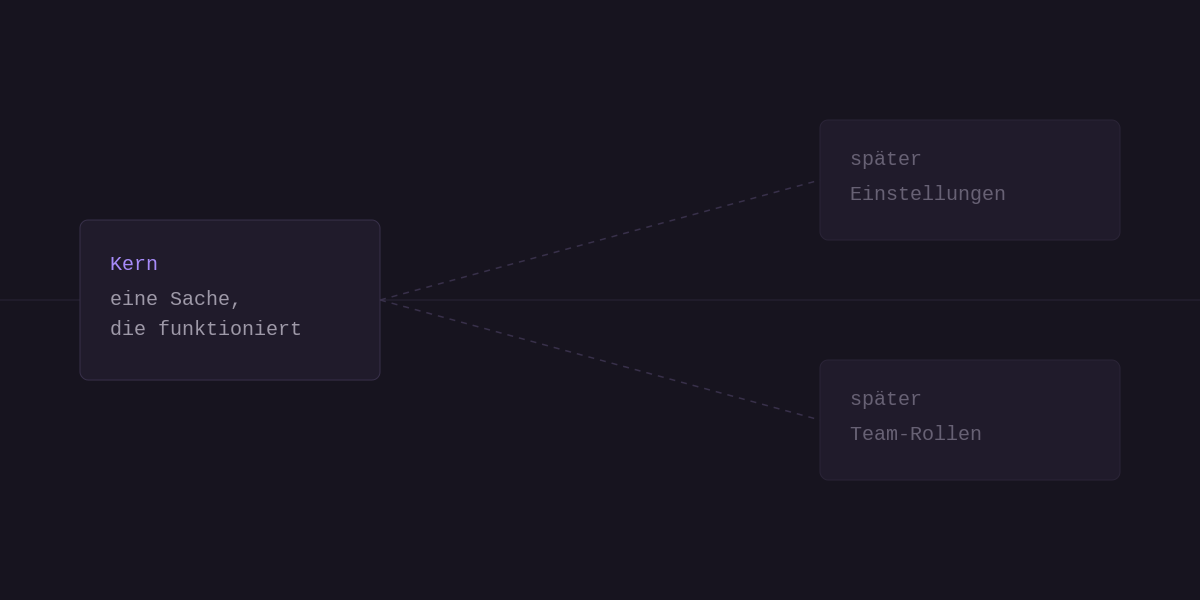
The core has to have value on its own
At the center of an MVP is one action that has to work completely.
Not five half-finished flows. Not an impressive interface with empty buttons. One thing that solves a real problem.
For a marketplace, that might mean someone can list an offer and someone else can respond to it. For a booking system, a booking actually has to be completable. For a photo platform, images have to be uploadable and viewable.
The core should be small, but not artificial.
An upload button without a working upload tests nothing. A booking form where the request manually lands in an inbox afterwards, on the other hand, can be entirely sufficient. What matters isn't how automated the solution is. What matters is whether the complete value is there for a first user.
Technically, the first version can absolutely be simpler than the one you'd build later. But it must not break the product's promise.
An MVP is not a bad finished product
A common misunderstanding takes shape around MVPs: take the planned product and strip a bit of quality from everywhere.
The result is an application where almost everything exists but nothing quite works.
Profiles already exist, they just can't be edited. Team roles exist, but the permissions are inconsistent. Notifications exist, but they only sometimes arrive. Settings exist, but they only save partially.
A version like that isn't focused. It's just unfinished.
A good MVP draws a clear line. Inside that line, the product works. Outside that line, the feature doesn't exist yet.
That's an important distinction.
A missing feature is understandable. An unreliable feature creates distrust.
What can wait
Many features feel indispensable during planning, because you immediately picture the finished product.
That often includes:
- different user roles
- extensive profile settings
- flexible notifications
- exports in multiple formats
- custom designs
- rare edge cases
- automation for processes that can initially be handled manually
These features can become important later. For the first test, they usually aren't.
So the better question isn't: "Will we need this eventually?"
The answer to that is almost always yes.
The better question is: "Does the absence of this feature stop us from testing our central assumption?"
If the answer is no, it waits.
Leaving things out has to be visible
Features you haven't built shouldn't be hidden behind disabled buttons or cryptic error messages.
If something is deliberately missing for now, you're allowed to say so.
A clear note is more honest than a half implementation:
function Settings() {
  // Deliberately later. The core has to hold up first.
  return <Placeholder note="Settings coming soon" />;
}
That way, users know they didn't do anything wrong. And the feedback you get stays useful.
If someone says: "I really need different team roles," that's concrete feedback about a missing feature.
If the same person spends ten minutes trying to figure out why a greyed-out invite button isn't responding, all you learn is that unclear interfaces are frustrating.
Leaving things out only works if the boundary is visible.
Edge cases need a boundary too
"Edge cases later" doesn't mean ignoring obvious failures.
A payment flow, for example, has to handle a declined payment. An upload has to respond in an understandable way if the connection drops. User data can't be left exposed just because it's the first version.
Other cases can deliberately wait. Maybe the first version doesn't support five different file formats yet. Maybe there's no complex permission management for large teams yet. Maybe exports initially only work as a ZIP file rather than also through Dropbox, Google Drive and a dedicated API.
The boundary runs wherever a missing case would damage the central promise or create an unnecessary risk.
Security, privacy and basic error handling aren't optional extras. Convenience features usually are.
The first user changes the priorities
Before launch, every feature can be justified convincingly.
After the first real users, the list usually gets noticeably shorter and, at the same time, more concrete.
Suddenly the biggest problem isn't the planned team management, but a confusing button. Not the missing dashboard, but an email sent at the wrong moment. Not the missing export interface, but an upload that fails too early on a particular iPhone.
That's the actual value of an MVP.
It doesn't confirm that the original plan was right. It shows which parts of the plan are even relevant.
For that, the first version has to reach real people early enough. An MVP that gets polished internally for months is just a smaller product with an unusually long development cycle.
When the MVP is big enough
The MVP is big enough when a user can complete the central flow without your personal explanation, and you can then observe a concrete reaction.
Did the person achieve the result they wanted?
Do they come back?
Are they willing to use the product again or pay for it?
Where do they drop off?
Which feature do they actually miss, and which one only when asked?
You don't need a perfect data set yet. But you need more than a friendly "looks cool" from someone who has never used the product.
An MVP should enable a decision. Keep building, change direction, or stop.
If the first version can't support any of these decisions, it was either too small or it tested the wrong thing.
Not everything gets built next
Once the core holds up, the entire original roadmap doesn't automatically come next.
The core only sets a direction.
Maybe the first users show that team roles matter, but the planned design options interest no one. Maybe a better onboarding process is needed first. Maybe the product works, but for a different audience than originally intended.
The features that follow should grow out of actual usage, not out of completing an old list.
That's exactly why a good MVP saves time. Not because building it is necessarily fast, but because it prevents weeks from flowing into features whose importance was so far only assumed.
The MVP stops where the product can do enough to be judged honestly.
Not less. But not more either.